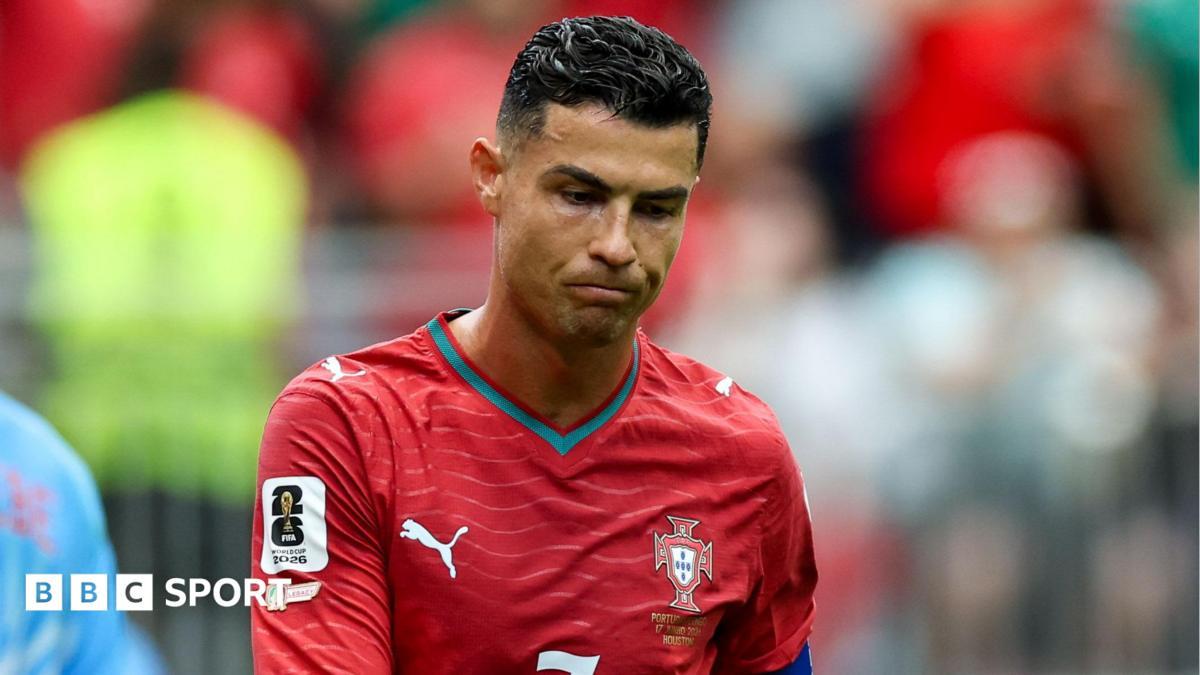
Social media is in an uproar. The post-match interviews are being analyzed in detail. Criticism of the Portuguese team increases. Cristiano Ronaldo's record, which equals his sixth and last World Cup, has attracted even more attention, but perhaps for unexpected reasons. It all started with a performance below expectations from the 41-year-old in the 1-1 draw with the Democratic Republic of Congo, in the team's debut at the tournament. From then on, a normal interview with João Neves was amplified, leading the group to a real crisis before the clash with Uzbekistan, scheduled for Tuesday (18:00 BST).
Neves, used to dealing with the press in difficult moments, had already faced a complicated situation in March 2024, after Benfica was defeated 5-0 by Porto, even though he had lost his mother a few days earlier. In his first season as a starter, he had to justify the result. Although the draw with the Democratic Republic of Congo may seem insignificant in comparison, his words in the post-match interview created a wave of criticism.
The Paris Saint-Germain midfielder was asked about Ronaldo's role in the team. "We know what Ronaldo did for our national team, but at this moment I feel that, for him and for all of us, he is just one more. He is here to contribute like all of us," said Neves. What followed was an unexpected reaction. Ronaldo fans flooded the social media accounts of Neves, Bruno Fernandes and others, accusing them of a lack of respect for their captain. This reaction, even by global superstar standards, was unprecedented. "This highlights the risk of a civil war that could emerge within the national team," said Vítor Pinto, from the Record newspaper.
The situation became even more complicated when people close to Ronaldo also got involved. His partner, Georgina Rodriguez, reacted to a false quote attributed to Neves' girlfriend, Madalena Aragão, before deleting the comment. Ronaldo's sisters, Katia and Elma Aveiro, shared posts that suggested an attempt to remove him from the team. On CMTV - the most watched television channel in Portugal, of which Ronaldo is a shareholder - commentator and lawyer Luís Miguel Henrique, who has represented him in business matters, cited a false quote attributed to Zinedine Zidane in defense of Ronaldo.

The turbulence ended up affecting the team's atmosphere in Palm Beach. "Is Portugal polarized between those who are with Cristiano and those who are not?" was a question raised repeatedly in press conferences. “This shouldn’t even be a topic of discussion,” replied Rúben Dias in a tense interview. Diogo Dalot commented the following day: "We know there are many people who don't want Portugal to win." Ignoring names, he added: "If I had to do that, we would never get out of here. It's not my place." Portugal knows that only a convincing victory against Uzbekistan can bring some peace - preferably with Ronaldo scoring, of course. Ronaldo has not scored in 10 consecutive games in major tournaments since a penalty against Ghana in the 2022 World Cup. Against the Republic of Congo, he had three shots - more than any other player - but failed to hit the target.
"Whenever we talk about Cristiano Ronaldo, it seems like Portugal is playing in his country," said Luis Aguilar, commentator for SIC Notícias. "It's as if there is a man much greater than the collective good, and that it is more important that things work out for Cristiano Ronaldo than for the team, when that shouldn't be the case. Because the reality today is that, contrary to the comparison often made with Lionel Messi, Cristiano Ronaldo is not the best player in the Portugal national team. Messi is still the best player in the Argentine national team." Despite the difficulties in his debut, number seven remained on the field for the 90 minutes. Under Roberto Martínez, he was substituted 13 times in the 30 matches he started, but only once before the 60th minute - in the 5-0 win against Armenia in September 2025. While Martínez refuses to define Ronaldo as untouchable, the numbers tell a different story.
"He is not the solution and that makes him part of the problem," said A Bola's executive director, Luís Mateus. "His goals used to compensate for his lack of defensive contribution. Now, he is no longer scoring and is affecting the entire attack. Mentally, because his teammates still want to serve him even when there are better options, but also because he has become an out-of-place part in the entire offensive process. He is on the field out of gratitude, not because of how he is playing." A recent survey by the website Zerozero revealed that 63% of Portugal fans who voted do not want him to start against Uzbekistan. This is not the first time that Ronaldo has arrived at a World Cup facing criticism due to his lack of goals for the national team. In 2010, the situation was even more complicated, as the Al-Nassr striker arrived in South Africa without scoring in competitive matches for the national team for two years. At the time, his response was more relaxed: "The goals are like ketchup. When they appear, they appear all at once," he said. He broke that fast in Portugal's 7-0 victory over North Korea in their second group game. In the end, it turned out to be the only goal of the tournament before Carlos Queiroz's team were eliminated by Spain in the round of 16.
"It's time to rethink some things, to spend less time on the beach [which generated controversy in the country] and more time in the boardroom," said former Tottenham and Chelsea coach André Villas-Boas, currently president of Porto. "Our ambitions remain enormous, because this is a golden generation and we want the man who gave so much to our country to leave the game holding the World Cup trophy, in the same way Messi did in Qatar. But the coach will manage his playing time as he sees fit. I believe we still have enough talent to leave a much better impression." This may be the only way to calm the debate about whether Portugal is a polarized team or not.