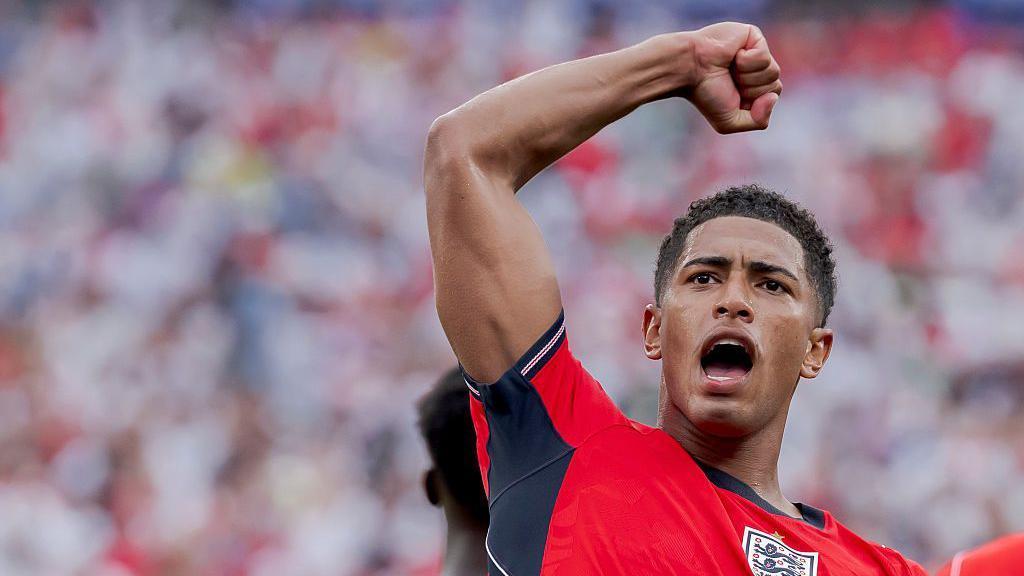
In June 2024, Jude Bellingham scored a dramatic 95th-minute bicycle kick against Slovakia to save England's Euro hopes. In the heat of the moment, he celebrated by shouting to the jubilant crowd: "Who else?" Following England's 2-0 victory against Panama, the 22-year-old's performance had a similar effect. Tuchel has been adamant that his system and approach will remain largely the same throughout the tournament, but subtle adjustments were seen on Saturday due to injuries in the squad. Bellingham was central in maximizing this system, plugging some gaps.
It was a tale of two halves for Bellingham, who was thrust into a more box-to-box role in Declan Rice's absence. In the first two games, England chose to build from the defense with the two central defenders and Elliott Anderson in the center of the field. Both full-backs took up wider positions as Rice and Bellingham left the defensive midfield areas for Harry Kane to join Anderson. This structure differed against Panama. Jarell Quansah came on at right-back in place of the injured Reece James and was asked to form part of a line of three in possession, alongside Marc Guehi and Ezri Konsa. Nico O'Reilly maintained his roaming left-back role.
Instead of Kane dropping back, Bellingham was tasked with supporting Anderson at the base of midfield and England's shape on the ball varied between a 3-2-5 and a 3-1-6, depending on Bellingham's reading of the game. After the game, Tuchel confirmed his intentions, explaining that Bellingham "played like a 10 when we had the ball" and that he wanted "to have six players in the back row" - probably in an attempt to overcome Panama's five-man defence.
Under Tuchel's leadership, England has a few guiding principles: attract pressure before accelerating the game, look for vertical passes to moving players, press intensely together when the ball is lost, build mainly through wide areas using triangles formed by full-back, winger and offensive midfielder, and maximize set pieces. Many of these principles were visible against Panama, but this time England also sought to build play in the center of the pitch - with mixed results. It seemed that England recognized that the players on the wings, who had been so effective before the tournament, were not enough in their current form. Coupled with James' injury, England needed an extra dimension and Bellingham's tactical intelligence and versatility were crucial.
Anderson made incisive passes forward whenever space appeared between the lines. With Kane, Morgan Rogers, O'Reilly and Bellingham positioned centrally at various times, England had a central presence. When playing in these areas, Panama converged on the ball, opening up space on the wings. However, given the way this has been an area of the pitch that England have not prioritized as much under Tuchel, introducing it during the tournament, without limited space players like Phil Foden, posed risks. Bellingham, a player who shines in large spaces, adapted his game. When he received the ball in these areas under pressure, he found unorthodox ways to pass the ball to the free players on the wings. If the spaces between the lines were too congested, he did well to win free kicks rather than lose the ball.

At half-time, Tuchel's assistant, Anthony Barry, reflected on England's game construction. "Our players wanted to get the game started quickly. The stadium felt like a home game, but all this energy distorted our risk management," said Barry. "We lost too much ball in the center, which opened space for counterattacks against a dangerous team. After 30 minutes, we gained more control in the game. [In the second half] we will reinforce [the search for] verticality and more speed in the last line." During the first 30 minutes, Bellingham's engine - primed by a season with fewer minutes in their legs compared to their Premier League counterparts - saved England on several occasions. Despite his superstar status, he made long, intense recovery runs before executing perfectly timed tackles to stop dangerous counterattacks. Immediately after the loss of possession, given England's riskier way of playing, Bellingham and many of the forwards converged around the ball, pressing effectively – a common trend in the Three Lions' three games so far.
England's ability to adapt to the game, whilst familiarizing themselves with some of these new tactical ideas that could help them in the later stages of the competition, built on Bellingham's work. In the second half, we saw Bellingham as a striker, who made the difference for both goals. His display made Barry's half-time statement about verticality and "more speed on the back line" seem prescient.
O'Reilly and Quansah, in their more central positions, compared to the wider positions of James and Djed Spence in the Ghana game, drew Panama's left and right midfielders inside. This created space for wingers Bukayo Saka and Marcus Rashford to receive the ball in one-on-one situations. A common routine used by England was Rashford running deep to receive a direct pass from defenders, with time and space on the ball. By retreating, he managed to find separation from the opposing full-back, who was drawn outside Panama's defensive line, which momentarily opened up space "in the last line" for someone with "speed" to attack, if Rashford played with "verticality". In the first half, this pattern occurred, but it was Kane who made the deep run and, despite all his quality, he is not the fastest. Rashford opted to cross the ball instead, but it was clear that Bellingham had his arm raised, pointing at the space where Kane was running, directing his teammate to look for that pass - the one that would be the source of both goals.
After the break, Bellingham's position was much more like a number 10 than a supporting midfielder for Anderson, which made these diagonal runs into the space behind the pressing full-back more viable. With Panama looking to apply some forward pressure, making a deep run against their momentum was extremely effective. It was a race that was difficult for the midfielders to react to and dragged the Panama center back out. The corner that broke the stalemate against Panama was won by Bellingham as he made that run before trying to deceive the defender with step-overs. The assist for Kane, once again, came from Bellingham's intelligence in reading this space, his physicality to run into it and his technical quality to deliver the cross.
Tuchel's system is working well. It may not be the easiest to watch against strong defences, but it looks suited to tournament football, providing England with a base on which to dominate possession whilst taking calculated risks. However, it is Bellingham's completeness that proved key in minimizing any uncertainty in doing so - a feat all the more impressive considering his place in the starting XI was the subject of much debate ahead of the World Cup.